This is the link to my final project:
http://hui-in-ningxia.blogspot.com/
Enjoy~~~~
Monday, March 29, 2010

Monday, March 22, 2010
Jews in China
It has been such an eye-opener to see many religions in China being unveiled throughout the course this year. At the beginning of the year, the only religion that I knew to exist in China was Buddhism because this is the only religion that I hear of and witnessed people practicing. Then, I learned that in China there were religions such as Nestorian Christianity, Manichaeism, Islam and now Judaism. Evidences can be found to prove that Jewish settlements in China began as early as the 9th century. This is fascinating because China was a country entirely different from the rest of the world at that time, yet people were still able to unite and live together. It was only by the Silk Roads that connected the east to the west together so that people of various backgrounds could travel and assimilate into other’s culture. It would intriguing to research about how the Jews in Kaifang assimilated into the Chinese culture, were they similar to the Hui, or Uighur. Did they even assimilate into the Chinese culture? If not, then how did the Chinese socially accept them?
This is a video about a Chinese born Jewish female talking about her life. She went Israel to learn Hebrew so that she could to help translate Jewish scriptures into Chinese for the Kaifang community. This is a way of maintaining the Jewish community in China!
This is a video about a Chinese born Jewish female talking about her life. She went Israel to learn Hebrew so that she could to help translate Jewish scriptures into Chinese for the Kaifang community. This is a way of maintaining the Jewish community in China!
Tuesday, February 9, 2010
Islam today
After reading Hirschkind and Mahmood’s article, I realized just how little I, the individual living in the West know about the East. Due to the media portrayal, we look at the East in a very materialist way, we judge the Middle East by what we hear and the images we see. In reality, what they value is not the same as what we do in the West. The westerns value fashion, education, careers, freedom of speech, and autonomy and many others, we then take these standards and compare them with other cultures. We view the East, in particular the Muslims as ‘bad people’ because men are violent and women are being oppressed by men and are forced to wear veils and burqas. Even in Canada, there are men who physically abuse their wife and children. Do we recognize that Western men to be violent? Women who do not leave their families even though they are being physically abused, aren’t they being oppressed? Where do we draw the line? How can the westerns say that they are right even, when similar things are occurring to them? This is what Edward Said outlined in his article, “The Clash of Ignorance,” the westerns considered themselves to be much more superior but at the same time, Islam has these powers to foretell the future. Where can we find the balance between the East and West? Is there a way for the West to equally treat the East?
Monday, February 1, 2010
Spread of Islam
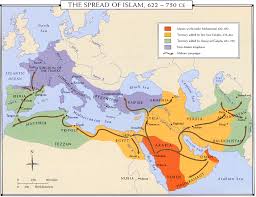
The above image is just a representation to the spread of Islam during the 6th-8th century.
According to Ayoub’s reading, I find it very interesting how Islam was able to spread so quickly across the Middle East and Asia, while the major religions: Buddhism, Judaism, Zoroastrianism, and Christianity coexisted. Today, Islam is one of the major religions in countries such as Malaysia, Indonesia and Brunei, that were under colonialism . It is fascinating to see how Islam was able to survive and spread even under colonial rule. Furthermore, it would be intriguing to see how Islam was at that time able to fit into other cultures and how people from other cultures accepted them. What makes Islam so special? Why did people back then accept this new religion? Yet, we are having so many issues with Muslims today. I guess the answer to these issues is , according to Ernest, is the fact that today we judge Muslims by what we see outside of them and not taking the time to understand what it really means to be a Muslim.
Monday, January 11, 2010
Group Topic 3: Manichaeism
Before we examine whether Manichaeism is a “syncretic” religion, we must first understand the meaning of syncretism.
The term syncretism refers to the combination of different forms of beliefs and practices. As a result, it creates a new teaching or belief system.
This is what makes Manichaeism so interesting to look because it is a syncretic tradition. In Hans-Joachim Klimkeit’s Gnosis on the Silk Road, it provides a detailed outline of the Manichaeism Doctrine including the basic concepts, principles, creation of the world and man, and salvation and damnation. Mani, the founder of Manichaeism basically, drew parts of beliefs from Christianity, Buddhism and Zoroastrianism and combined them together to make his own religion. He portrays Jesus into three figures, 1. “Jesus the Splendor,” from Christianity 2. “The Messiah Buddha,” from Buddhism and 3. “The suffering Jesus,” captured by darkness from Zoroastrianism. Therefore, he refers himself as the prophet, having all these advanced knowledge and called to preach about it.
H.J. Polotsky points out, “is a remarkably unified, symmetrical system in spite of the great diversity of sources from which it may be gleaned.”
In the end of the day, I can understand Mani’s purpose for creating this ‘new’ religion called Manichaeism. It all comes down to, the attempt to answer the unknown. Who created the world? Who created humans? Which religion in world is correct? These questions can be answered depending on the religion each individual believe in. However, for Mani, he realized that all three religions made sense and if you combined them together, we can get a definite answer and everyone would believe in the same thing. His purpose was to unify all the people in world through a common belief system by syncretising all the major religions in the world.
The term syncretism refers to the combination of different forms of beliefs and practices. As a result, it creates a new teaching or belief system.
This is what makes Manichaeism so interesting to look because it is a syncretic tradition. In Hans-Joachim Klimkeit’s Gnosis on the Silk Road, it provides a detailed outline of the Manichaeism Doctrine including the basic concepts, principles, creation of the world and man, and salvation and damnation. Mani, the founder of Manichaeism basically, drew parts of beliefs from Christianity, Buddhism and Zoroastrianism and combined them together to make his own religion. He portrays Jesus into three figures, 1. “Jesus the Splendor,” from Christianity 2. “The Messiah Buddha,” from Buddhism and 3. “The suffering Jesus,” captured by darkness from Zoroastrianism. Therefore, he refers himself as the prophet, having all these advanced knowledge and called to preach about it.
H.J. Polotsky points out, “is a remarkably unified, symmetrical system in spite of the great diversity of sources from which it may be gleaned.”
In the end of the day, I can understand Mani’s purpose for creating this ‘new’ religion called Manichaeism. It all comes down to, the attempt to answer the unknown. Who created the world? Who created humans? Which religion in world is correct? These questions can be answered depending on the religion each individual believe in. However, for Mani, he realized that all three religions made sense and if you combined them together, we can get a definite answer and everyone would believe in the same thing. His purpose was to unify all the people in world through a common belief system by syncretising all the major religions in the world.
Subscribe to:
Posts (Atom)